
Introduction
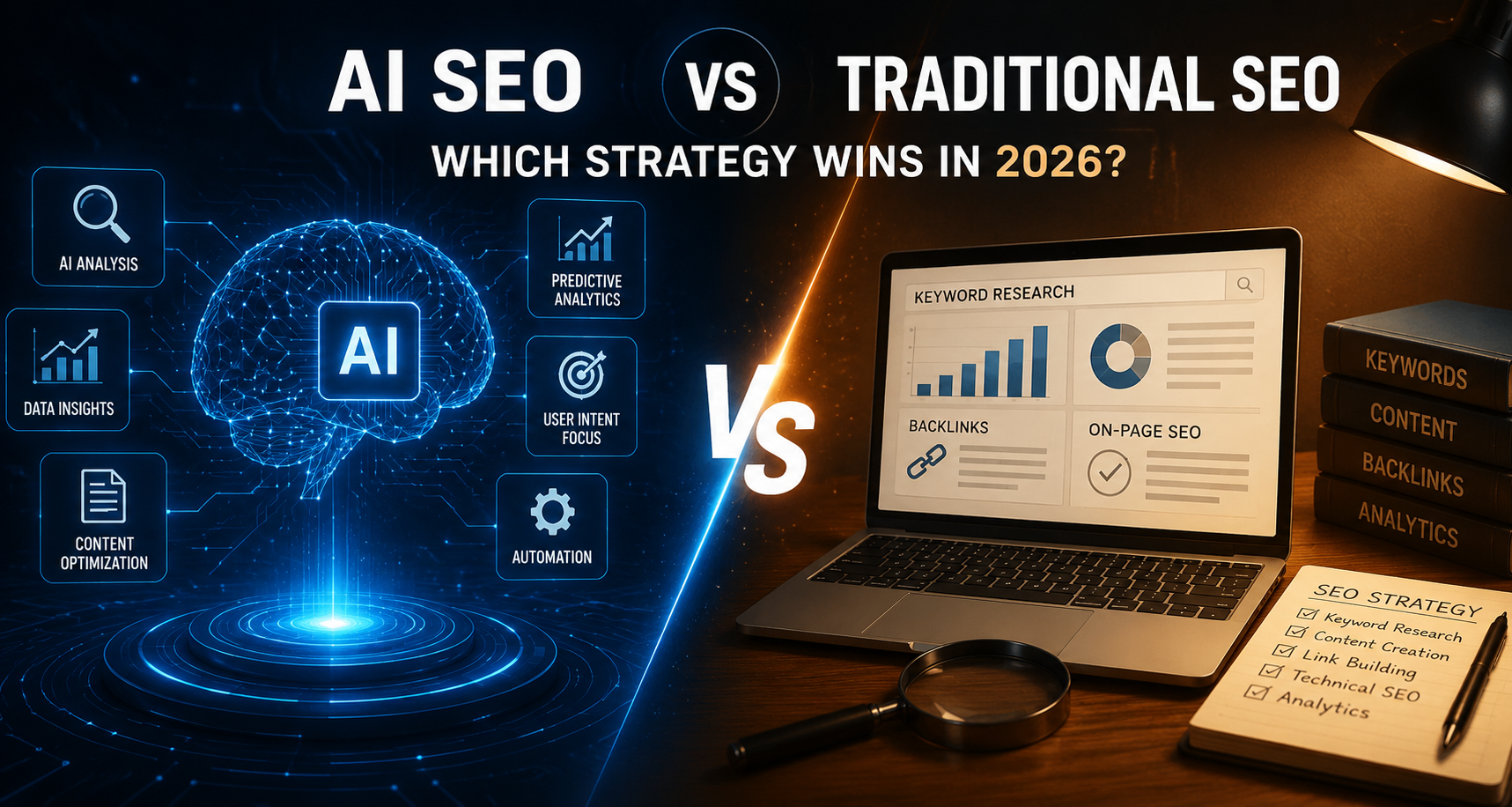
Search engine optimization has evolved dramatically over the past few years. What once revolved around keyword density, backlinks, and technical optimization has now expanded into a more intelligent ecosystem driven by artificial intelligence. With Google’s AI-powered search experiences and the growing use of AI assistants to answer user queries, businesses are asking an important question: Is traditional SEO still enough, or is AI SEO the future?
The answer is not as simple as choosing one over the other. In 2026, successful digital marketing strategies combine the proven foundations of traditional SEO with the speed, efficiency, and intelligence of AI SEO. Understanding how these approaches differ can help businesses stay competitive and improve their online visibility.
Understanding Traditional SEO
Traditional SEO is the practice of optimizing a website to improve its rankings in search engine results pages. It focuses on creating high-quality content, optimizing on-page elements, improving website speed, earning backlinks, and ensuring a strong technical foundation.
For years, traditional SEO has helped businesses generate organic traffic by targeting relevant keywords and providing valuable content that satisfies user intent. The process involves careful keyword research, content optimization, internal linking, schema implementation, mobile responsiveness, and continuous performance monitoring.
Although search engines have become more sophisticated, these core principles continue to play a vital role in achieving long-term rankings.
What Is AI SEO?
AI SEO refers to the use of artificial intelligence to improve every stage of the SEO process. Instead of relying solely on manual research and analysis, AI-powered tools can identify keyword opportunities, analyze competitors, generate content ideas, optimize existing pages, predict search trends, and automate repetitive SEO tasks.
Modern AI tools can process massive amounts of data within seconds, allowing marketers to make faster decisions and discover opportunities that would otherwise take hours or even days to identify.
However, AI SEO is not about replacing human expertise. It is about enhancing productivity while allowing marketers to focus on strategy, creativity, and user experience.
How Search Has Changed in 2026
Search behavior has changed significantly as users increasingly rely on AI-powered search experiences. Instead of typing short keywords, people now ask complete questions and expect conversational answers.
Search engines have also become better at understanding context, intent, expertise, and content quality. Rather than rewarding pages that simply include keywords, they prioritize content that genuinely solves user problems and demonstrates authority.
This shift means businesses must create content that is informative, trustworthy, and structured in a way that AI search engines can easily understand and reference.
The Advantages of Traditional SEO
Traditional SEO continues to provide a strong foundation for sustainable online growth. High-quality website architecture, optimized page speed, clean technical implementation, and authoritative backlinks remain important ranking factors.
Businesses that invest in traditional SEO often build lasting authority within their industry. Their content continues to generate traffic for months or even years after publication, making SEO one of the highest-return digital marketing investments.
Traditional SEO also gives businesses greater control over content quality and brand messaging, ensuring that every page aligns with business goals and customer expectations.
The Advantages of AI SEO
AI SEO dramatically improves efficiency by automating many time-consuming tasks. It can analyze thousands of keywords, identify content gaps, suggest optimization opportunities, and provide actionable insights almost instantly.
Content teams can use AI to generate outlines, improve readability, optimize headings, create metadata, and identify semantic keywords that strengthen topical authority.
AI also enables businesses to adapt more quickly to algorithm updates and emerging search trends by continuously analyzing data and recommending improvements.
For companies managing large websites with hundreds or thousands of pages, AI SEO can significantly reduce workload while improving consistency.
Where AI SEO Falls Short
Despite its advantages, AI SEO is not perfect. Artificial intelligence can generate content quickly, but it cannot replace human expertise, creativity, or real-world experience.
Search engines increasingly prioritize authentic, experience-based content that demonstrates expertise and trustworthiness. AI-generated content without proper editing often lacks originality, depth, and unique insights.
Businesses that rely entirely on AI-generated articles risk publishing generic content that fails to stand out in competitive search results.
Human review remains essential for ensuring factual accuracy, maintaining brand voice, and delivering genuine value to readers.
Why Traditional SEO Alone Is No Longer Enough
While traditional SEO remains essential, relying only on manual processes can slow growth in today’s competitive environment.
Competitor research, keyword analysis, content optimization, technical audits, and reporting all require significant time when completed manually. AI allows marketers to perform these tasks more efficiently while uncovering opportunities that might otherwise be overlooked.
Businesses that refuse to adopt AI often struggle to keep pace with competitors who can produce optimized content faster and respond more quickly to market changes.
The Winning Strategy for 2026
The businesses achieving the best SEO results in 2026 are not choosing between AI SEO and traditional SEO. They are combining both approaches.
AI handles research, automation, data analysis, and optimization suggestions, while experienced marketers focus on strategy, content quality, branding, storytelling, and user experience.
This balanced approach produces content that is both technically optimized and genuinely valuable to readers.
Instead of replacing SEO professionals, AI empowers them to work smarter and achieve better outcomes.
Final Thoughts
The debate between AI SEO and traditional SEO should not be viewed as a competition. Traditional SEO provides the strong technical and strategic foundation that search engines continue to value, while AI SEO introduces speed, efficiency, and data-driven decision-making.
In 2026, the most successful businesses will be those that embrace AI as a powerful assistant rather than a replacement for human expertise. Organizations that combine intelligent automation with high-quality, people-first content will be better positioned to earn higher rankings, attract qualified traffic, and build long-term authority online.
As search continues to evolve, one thing remains constant: creating valuable content that genuinely helps users will always be the strongest SEO strategy.