
Introduction
Search is changing rapidly. For years, businesses focused on optimizing their websites to appear in traditional Google search results. Today, users are increasingly turning to AI-powered search experiences to find information, compare businesses, discover products, and answer complex questions.
AI search engines and AI-powered search features are changing how information is discovered and presented. Instead of simply displaying a list of links, these systems can understand questions, combine information from multiple sources, and provide conversational answers.
This shift creates a new opportunity for businesses. Websites that provide clear, authoritative, useful, and well-structured information have a better chance of being discovered and referenced within AI-driven search experiences.
Optimizing for AI search does not mean abandoning traditional SEO. Instead, businesses need to build on strong SEO fundamentals while creating content that is easy for both search engines and AI systems to understand.
What Is AI Search?
AI search refers to search experiences that use artificial intelligence to understand user queries and provide more contextual and conversational results.
Traditional search generally matches queries with webpages based on factors such as relevance, authority, content quality, links, and technical signals. AI-powered search can go further by understanding the context behind a question and synthesizing information from different sources.
Users can ask detailed questions in natural language rather than relying only on short keywords. This means businesses need to think beyond individual keywords and focus on answering the questions their target audience actually asks.
Why AI Search Matters for Businesses
The way people discover businesses online is evolving.
A potential customer may no longer search only for a phrase such as “digital marketing agency in Noida.” They might ask an AI-powered search engine which digital marketing agency is suitable for a growing business, what services an agency should offer, or how to compare SEO agencies in a particular location.
If your website contains useful, detailed, and trustworthy information that addresses these questions, it can increase the chances of your business being discovered across modern search experiences.
For businesses, this means visibility is no longer limited to traditional search rankings. Building digital authority and becoming a reliable source of information are increasingly important.
Create Content That Answers Real Questions
One of the most effective ways to prepare your website for AI search is to create content around genuine customer questions.
Instead of writing articles solely around a keyword, consider what someone would actually want to know before making a decision.
For example, a digital marketing agency could create content explaining how SEO works, how businesses can measure SEO performance, what makes a good digital marketing strategy, how much businesses should invest in online marketing, and how to choose the right marketing agency.
This approach creates comprehensive resources that address multiple aspects of a topic rather than focusing on a single search phrase.
Focus on Search Intent
Understanding search intent is essential for both traditional SEO and AI search optimization.
People search for different reasons. Some want to learn something, some are comparing solutions, and others are ready to contact a service provider.
Your content should match the intent behind the search.
An informational article should provide genuine education rather than aggressively promoting your services. A service page should clearly explain what you offer, who it is for, and why customers should consider your business.
When content directly satisfies the user’s purpose, it becomes more useful and relevant.
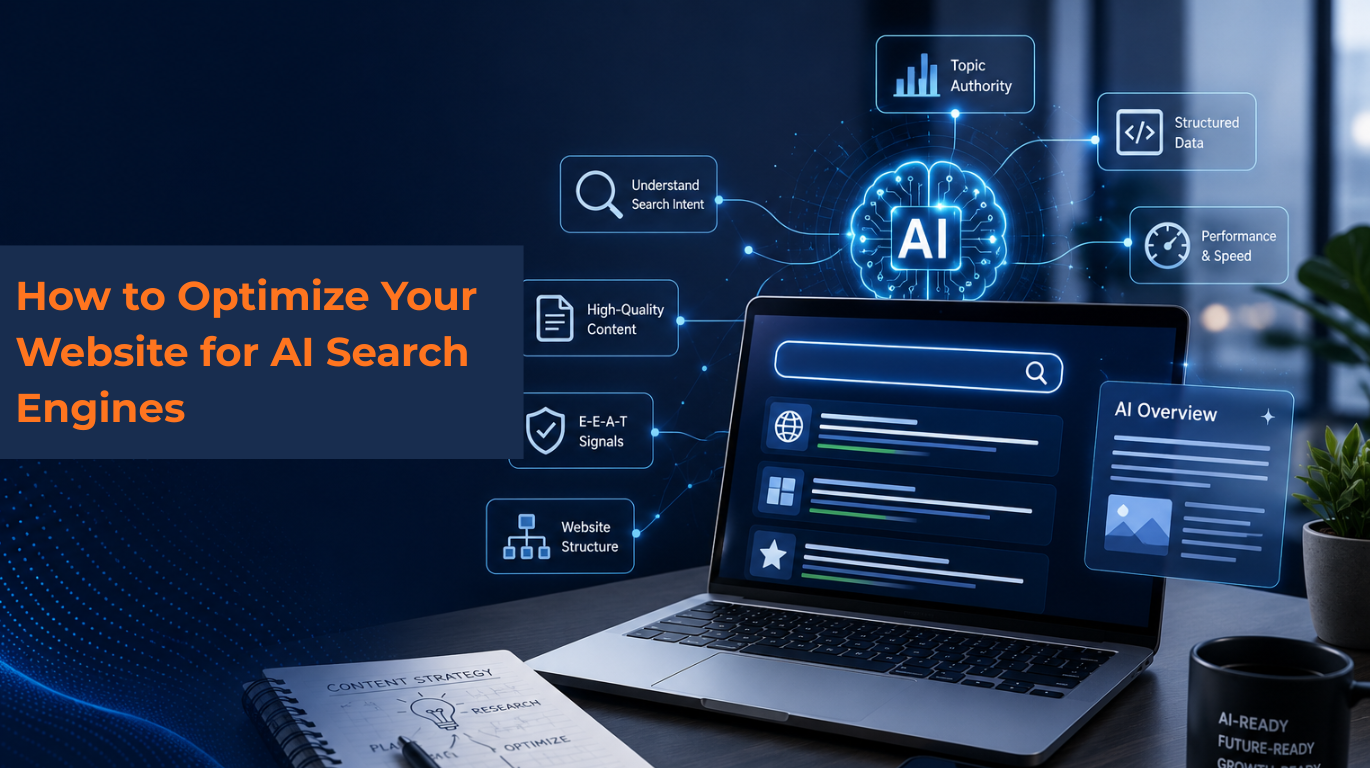
Build Topic Authority
AI-powered search systems need to identify reliable sources when generating responses. Building authority around a specific subject can therefore become increasingly valuable.
Rather than publishing unrelated articles across dozens of subjects, businesses should develop clusters of content around their core areas of expertise.
For a digital marketing agency, this could include comprehensive content around SEO, local SEO, technical SEO, social media marketing, Google Ads, content marketing, branding, website development, influencer marketing, and AI-driven search optimization.
Multiple high-quality resources covering related subjects help establish your website as a knowledgeable source within your industry.
Make Your Content Easy to Understand
Complex writing does not necessarily make content more authoritative.
AI systems and human readers both benefit from information that is clearly organized and logically structured.
Use descriptive headings, concise paragraphs, clear explanations, relevant examples, and natural language. Break complicated concepts into sections that are easy to understand.
A well-structured article makes it easier for search engines and AI systems to identify important information and understand how different topics relate to one another.
Strengthen Your Website’s E-E-A-T Signals
Experience, Expertise, Authoritativeness, and Trustworthiness are important concepts in modern search optimization.
Businesses should clearly demonstrate why they are qualified to discuss the subjects covered on their websites.
Author biographies, detailed service pages, case studies, client experiences, original research, industry insights, and accurate business information can help strengthen credibility.
For a digital marketing agency, demonstrating practical experience through successful campaigns, industry knowledge, strategy guides, and detailed case studies can make the website more authoritative.
Use Original Information and Insights
Generic content is becoming increasingly easy to produce.
Businesses can differentiate themselves by publishing information that provides something genuinely useful and original.
Instead of simply rewriting information already available online, share your own observations, campaign experiences, data, examples, processes, or expert opinions where appropriate.
Original insights give your content greater value and can help establish your website as a source worth referencing.
Optimize Your Website Structure
AI search optimization still depends on strong technical SEO.
Search engines need to be able to crawl, understand, and index your website efficiently. A clear site structure makes this process easier.
Important service pages should be logically connected to supporting blog content. Internal links should help users and search engines discover related information.
Your website should also have clean URLs, properly structured headings, optimized images, an XML sitemap, appropriate canonicalization, and a mobile-friendly design.
Technical problems can prevent even excellent content from reaching its full search potential.
Improve Website Speed and Mobile Experience
A website designed for modern search should provide an excellent user experience across devices.
Slow loading pages, confusing navigation, intrusive elements, and poor mobile layouts can negatively affect user engagement.
Optimizing image sizes, reducing unnecessary scripts, improving hosting performance, and maintaining a responsive website can help create a faster and more accessible experience.
A technically strong website gives your content a better foundation for search visibility.
Use Structured Data Where Appropriate
Structured data helps search engines understand specific information on webpages.
Depending on the type of content, businesses may use relevant structured data to describe articles, organizations, local businesses, products, services, events, and other entities.
Structured data does not guarantee that your content will appear in a particular AI search feature. However, providing clear machine-readable information can help search engines better understand the content and context of your website.
The implementation should always follow current search engine guidelines.
Build Strong Internal Linking
Internal linking is often overlooked when businesses focus on AI search.
A well-planned internal linking structure connects related pages and helps search engines understand the relationship between different topics.
For example, a comprehensive SEO guide could link to separate articles about keyword research, technical SEO, local SEO, content optimization, link building, and AI search optimization.
This creates a connected knowledge structure rather than a collection of isolated blog posts.
Maintain Accurate Business Information
Businesses should ensure that important information is consistent and accurate across their website and other trusted online platforms.
Your business name, services, location, contact information, areas served, and company descriptions should be clearly presented.
For businesses targeting local customers, maintaining accurate local business information is particularly important because search systems use information from multiple sources when understanding businesses and locations.
Earn High-Quality Mentions and Links
Authority is not built only on your own website.
Relevant mentions, citations, digital PR coverage, industry publications, partnerships, and high-quality backlinks can strengthen your website’s overall authority.
The focus should be on earning genuine recognition from relevant and trustworthy sources rather than purchasing large quantities of low-quality links.
A smaller number of relevant, authoritative references can be considerably more valuable than hundreds of unrelated links.
Keep Your Content Updated
AI search and traditional search both operate in an environment where information changes constantly.
Outdated statistics, old recommendations, broken links, discontinued services, and obsolete information can reduce the usefulness of your content.
Review important pages periodically and update them when new information becomes available.
Updating existing high-value content can often be more effective than continuously publishing new articles without maintaining older resources.
Don’t Abandon Traditional SEO
Optimizing for AI search does not mean traditional SEO is no longer relevant.
Search engines still rely on fundamental signals such as crawlability, indexing, content relevance, website quality, links, technical performance, and user experience.
The strongest strategy is to combine traditional SEO with content designed for conversational and AI-driven search.
Businesses that maintain strong SEO foundations while developing genuine topical authority will be better positioned as search continues to evolve.
How Brandinning Can Help
Optimizing a website for modern search requires more than publishing occasional blog posts.
A comprehensive strategy should combine technical SEO, keyword research, content marketing, on-page optimization, local SEO, website performance, authority building, and ongoing analysis.
Brandinning helps businesses build stronger digital visibility through customized digital marketing strategies designed around their business objectives and target audience.
As search continues to evolve, businesses need an approach that focuses not only on rankings but also on visibility, credibility, qualified traffic, and long-term growth.
Conclusion
AI search is changing the way people discover information and businesses online. Companies that want to remain visible need to adapt their SEO strategies to this changing environment.
The key is not to create content specifically for machines. Instead, businesses should create genuinely useful content that answers real questions, demonstrates expertise, provides original insights, and offers a strong user experience.
A technically sound website, comprehensive content strategy, strong internal linking, authoritative references, accurate business information, and continuous optimization can help build a stronger foundation for both traditional and AI-powered search.
The future of search belongs to businesses that can provide the right information, demonstrate genuine expertise, and earn the trust of both users and search systems.