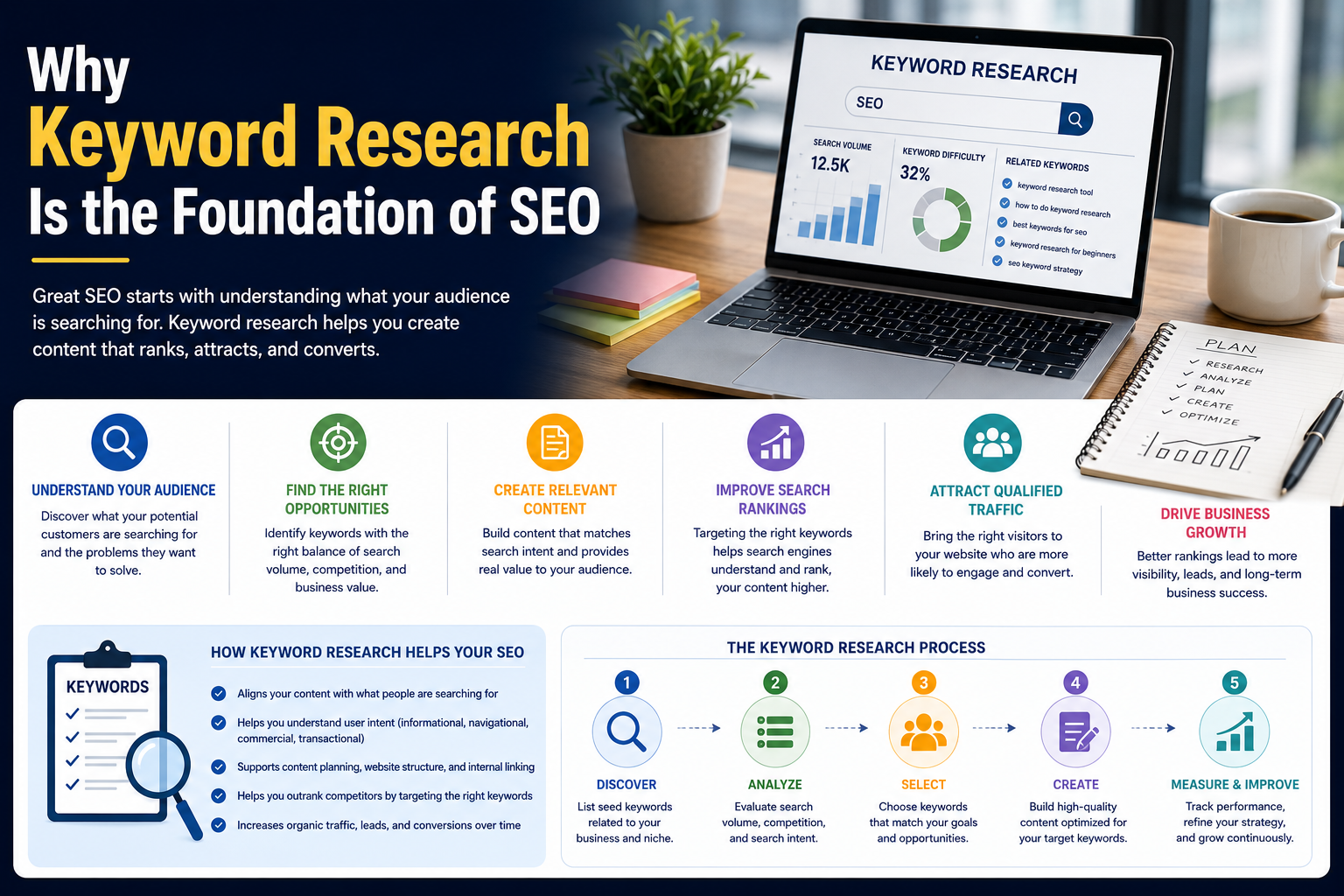
Every successful SEO strategy begins with one essential step: keyword research. Before you optimize a website, write a blog, or launch a digital marketing campaign, you need to understand what your target audience is searching for online. Keyword research provides these insights and serves as the roadmap for creating content that attracts the right visitors.
Many businesses invest time and resources into publishing content without knowing whether people are actually searching for the topics they cover. As a result, they struggle to generate traffic, leads, and conversions. Keyword research eliminates this guesswork by helping you identify the exact words and phrases your potential customers use on search engines.
In this blog, we’ll explore why keyword research is considered the foundation of SEO, how it influences your website’s performance, and how businesses can use it to achieve sustainable organic growth.
What Is Keyword Research?
Keyword research is the process of discovering the words, phrases, and questions that people type into search engines like Google when looking for information, products, or services.
These keywords represent user intent. They reveal what people want, the problems they are trying to solve, and the solutions they expect to find. By understanding these search queries, businesses can create content that directly matches user needs and increases the chances of appearing in search results.
Rather than creating content based on assumptions, keyword research allows marketers to make data-driven decisions that improve visibility and attract qualified visitors.
Why Keyword Research Matters
Search engines aim to provide users with the most relevant answers to their queries. If your website contains content that closely aligns with what people are searching for, it has a better chance of ranking well.
Keyword research helps businesses understand their audience, identify market demand, and create content that answers real questions. It ensures that every blog, landing page, and service page has a clear purpose and targets a specific search intent.
Without keyword research, even high-quality content may fail to reach the right audience simply because it isn’t optimized for the terms people actually use.
Understanding Search Intent
One of the most valuable aspects of keyword research is understanding search intent. Every search query reflects a specific goal, and recognizing that goal helps you create content that satisfies user expectations.
Informational searches are made by users looking to learn something, such as “what is local SEO” or “how does Google ranking work.”
Navigational searches occur when users are trying to find a particular website or brand.
Commercial searches indicate that users are comparing products or services before making a decision.
Transactional searches show strong buying intent, such as “hire SEO agency” or “best digital marketing company near me.”
Matching your content with the correct search intent significantly improves user satisfaction and increases the likelihood of higher rankings.
How Keyword Research Improves SEO Performance
Keyword research influences almost every aspect of search engine optimization.
It helps determine which topics your audience is interested in, guides the structure of your website, improves content planning, supports internal linking strategies, and ensures that important pages target relevant search terms.
By focusing on keywords with realistic ranking opportunities, businesses can steadily build organic traffic while competing more effectively in their industry.
Well-researched keywords also help search engines understand the purpose of each page, making it easier for them to index and rank your content appropriately.
Finding the Right Keywords
Not every keyword is worth targeting. Some keywords are highly competitive, while others have low search volume or limited commercial value.
A successful keyword strategy considers several factors, including search volume, competition, relevance, user intent, and business goals.
Broad keywords may generate significant traffic but are often difficult to rank for. Long-tail keywords, on the other hand, typically have lower competition and attract users with more specific needs.
For example, instead of targeting a broad keyword like “SEO,” a business may achieve better results by focusing on phrases such as “SEO services for small businesses” or “local SEO agency in Noida.”
These targeted keywords often lead to higher conversion rates because they attract users with a clear purpose.
The Role of Long-Tail Keywords
Long-tail keywords consist of three or more words and are usually more specific than broad search terms.
Although they often have lower search volumes, they attract highly targeted visitors who are closer to making a purchasing decision.
Someone searching for “digital marketing” may simply be gathering information, while someone searching for “best digital marketing agency for healthcare clinics” has a much more defined requirement.
Creating content around long-tail keywords allows businesses to reach niche audiences while improving their chances of ranking on the first page of search results.
Keyword Research Helps You Understand Your Customers
Keyword research provides valuable insights into customer behavior.
It reveals the language your audience uses, the questions they frequently ask, the challenges they face, and the solutions they seek.
These insights help businesses develop content that addresses real customer concerns instead of relying on assumptions.
Understanding customer intent also improves messaging across websites, advertisements, email campaigns, and social media content.
Competitor Analysis Starts with Keywords
Keyword research also helps businesses understand what their competitors are doing successfully.
By analyzing the keywords competitors rank for, you can identify content gaps, discover new opportunities, and create more comprehensive resources.
Competitor analysis does not mean copying existing content. Instead, it allows you to produce higher-quality, more informative, and more valuable content that better serves your audience.
This approach increases your chances of outranking competitors over time.
Supporting Content Marketing Strategy
Keyword research forms the backbone of every effective content marketing strategy.
It helps businesses identify blog topics, create service pages, develop FAQs, write product descriptions, and build content clusters around core subjects.
Instead of publishing random articles, businesses can create structured content that strengthens topical authority and improves search engine visibility.
For example, a digital marketing agency targeting SEO services could build supporting articles around keyword research, technical SEO, local SEO, on-page optimization, backlink strategies, and SEO reporting.
This interconnected approach helps search engines recognize expertise within a particular subject area.
Common Keyword Research Mistakes
Many businesses make the mistake of targeting only high-volume keywords while ignoring user intent and competition.
Others use the same keyword excessively, resulting in keyword stuffing that negatively impacts readability and SEO performance.
Some websites fail to update their keyword strategy as search trends evolve, causing their content to lose relevance over time.
Another common mistake is creating multiple pages targeting the same keyword, leading to keyword cannibalization where pages compete against each other in search results.
A balanced keyword strategy focuses on relevance, quality, and user experience rather than simply chasing search volume.
Best Tools for Keyword Research
Several professional tools can help businesses identify valuable keyword opportunities.
Google Keyword Planner provides search volume and keyword suggestions directly from Google’s advertising platform.
Google Search Console offers insights into the queries that already drive traffic to your website.
SEMrush and Ahrefs provide competitive keyword analysis, backlink research, and ranking opportunities.
Ubersuggest helps identify keyword ideas and content opportunities for businesses of all sizes.
Google Trends is useful for monitoring seasonal search behavior and identifying emerging topics.
Using a combination of these tools provides a more complete understanding of search demand and market opportunities.
Why Keyword Research Delivers Long-Term Results
Unlike paid advertising, where traffic stops as soon as the budget ends, keyword-optimized content can continue attracting visitors for months or even years.
When businesses consistently publish valuable content based on well-researched keywords, they build topical authority, improve domain credibility, and earn sustainable organic traffic.
This long-term approach reduces dependence on paid advertising while generating consistent leads and brand visibility.
Keyword research is therefore not just an SEO activity it is a long-term investment in your website’s growth.
Conclusion
Keyword research is the foundation of every successful SEO strategy because it connects your business with the people actively searching for your products or services. It removes guesswork from content creation, helps you understand customer intent, improves search engine visibility, and supports long-term organic growth.
Whether you’re optimizing an existing website or launching a new digital marketing campaign, investing time in thorough keyword research ensures that every page you create serves a clear purpose and reaches the right audience.
At Brandinning, we use data-driven keyword research to build SEO strategies that attract qualified traffic, improve search rankings, and generate meaningful business growth. By identifying the keywords that matter most to your audience, we help businesses create content that not only ranks well on search engines but also converts visitors into loyal customers.